
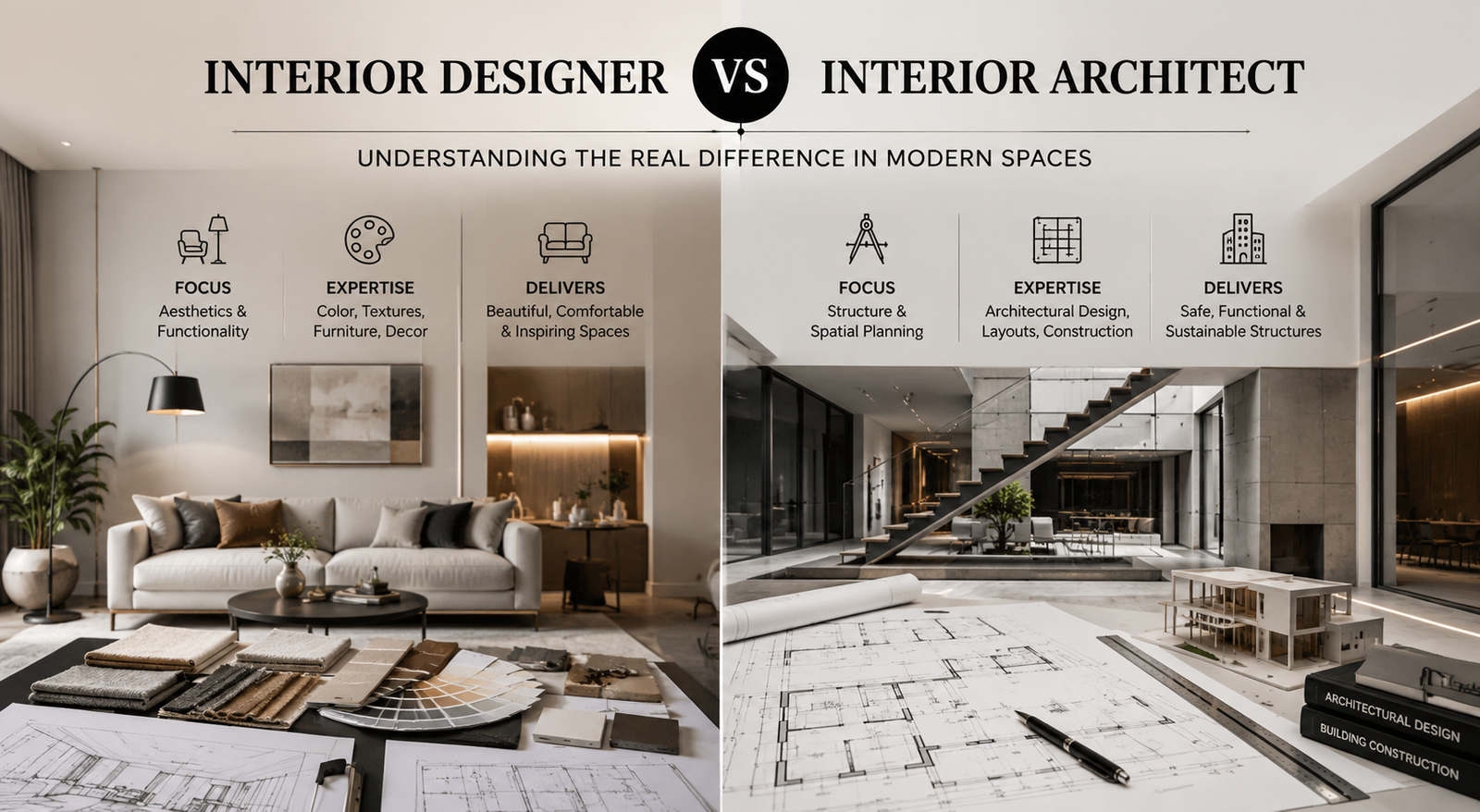
In today’s evolving design industry, the terms Interior Designer and Interior Architect are often used interchangeably. While both professionals work toward creating aesthetically pleasing and functional spaces, their expertise, technical involvement, and project responsibilities are significantly different.
At Neelanjan Gupto Design Co., we believe every successful project begins with understanding not just how a space should look, but how it should function, flow, and emotionally connect with the people using it.
Whether you are designing a luxury residence, a modern office, a retail outlet, or a hospitality space, understanding the difference between an interior designer and an interior architect can help you make the right decision for your project.
An Interior Designer primarily focuses on enhancing the visual appeal, comfort, and functionality of an interior space. Their work revolves around aesthetics, furniture layouts, material selection, lighting concepts, color palettes, décor styling, and creating a cohesive design language.
An experienced interior designer transforms ordinary spaces into refined environments that reflect personality, luxury, and functionality.
At Neelanjan Gupto Design Co., our design approach goes beyond trends. We create timeless interiors that balance elegance, practicality, and emotional connection.
An Interior Architect works at a more structural and technical level. Interior architecture combines architecture with interior design to redefine how internal spaces are built, modified, and experienced.
Interior architects are involved in:
Their role becomes crucial when projects require architectural intervention, layout transformation, or major structural changes.
Unlike traditional decorating, interior architecture addresses the technical backbone of a space while maintaining aesthetic value.
Interior Designer | Interior Architect |
|---|---|
Focuses on aesthetics and functionality | Focuses on structure and spatial architecture |
Works with furniture, décor, colors, lighting | Works with layouts, structural modifications, technical planning |
Enhances existing spaces | Reconstructs and redesigns spaces internally |
More visual and styling-oriented | More technical and architectural |
Ideal for furnishing and luxury styling | Ideal for renovation and structural redesign |
Handles mood, ambiance, and visual appeal | Handles internal construction and spatial engineering |
While both professions overlap in certain areas, the real difference lies in the depth of technical involvement.
At Neelanjan Gupto Design Co., we bridge both worlds by integrating architectural thinking with refined interior design execution.
Modern lifestyles demand more than beautiful interiors. Today’s clients seek spaces that are:
This is where a multidisciplinary approach becomes essential.
A luxury residence is not defined only by expensive materials. It is defined by:
At Neelanjan Gupto Design Co., every project is approached with architectural precision and artistic sophistication.
India’s design landscape is shifting as clients seek more than just decor. With urban spaces becoming more compact and property values rising, the need for functional, technically sound, and vastu-conscious interiors has made interior architecture essential for both homes and businesses.
At Neelanjan Gupto Design Co., we believe a space should tell a unique story. Our process blends architectural precision with artistic flair to create environments that are as functional as they are beautiful.
We believe interior spaces should tell a story.
Every project is thoughtfully curated through a process that combines:
Hiring a professional interior design and architecture studio offers advantages beyond aesthetics.